The essential study guide for nail tech students and salon workers who need to understand the theory in a clear, visual, and easy-to-remember way.
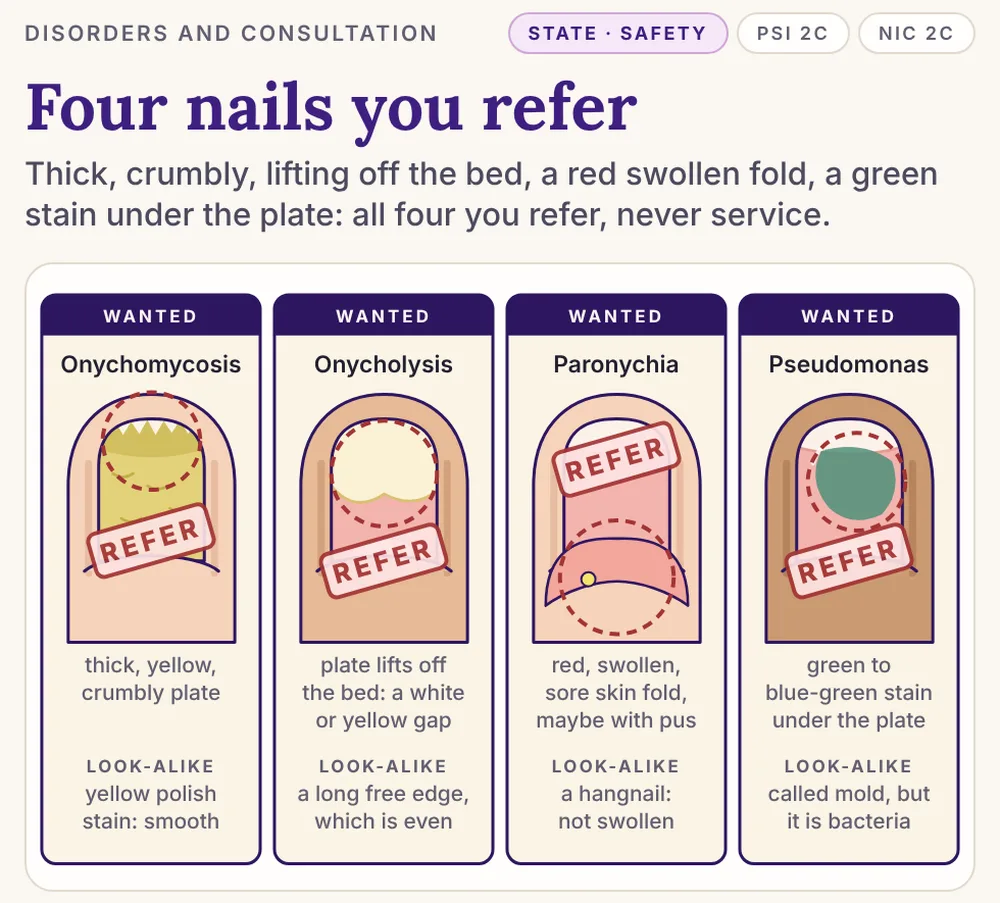
Swipe through real pages from Book 1. Every page is one idea, one drawing, and the exam areas it belongs to.
A theory book with 85 illustrated one-idea pages, 60 rapid review cards, and an illustrated A to Z of 182 nail tech terms.
A drawing does the explaining, and the text stays short. You remember the picture on exam day.
Portrait pages sized for a phone screen. Study between clients, on the bus, or after the salon closes. Print them if you prefer paper.
About 1 in 3 don’t pass
That’s roughly how many nail tech written exams end in a fail.
The toughest topics are the ones that are easy to mix up and hard to memorize:

A picture is easier to remember than a list of terms. That’s why every one of these is drawn out in the kit.
Source: Texas TDLR exam statistics, fiscal year 2025: 6,529 of 9,591 manicurist written sittings passed (68%), retakes included. Topic weights: PSI bulletin 713 (January 2026) and PSI national outline v1.1.
Decontamination is the process of removing debris and harmful microorganisms from tools and surfaces so that they are safe to use on the next client. Decontamination takes place at different levels, and the level required depends on the type of implement, whether it is porous or nonporous, whether it has come into contact with broken skin, and on the rules of the state in which the nail technician is licensed. The first level is cleaning, a mechanical process that uses soap and water or a detergent to remove visible dust, debris, product residue and many microorganisms from a surface. Cleaning must always come before disinfection, because residue left on an implement can prevent the disinfectant from reaching the surface. The second level is disinfection, a chemical process that destroys most microorganisms on hard, nonporous surfaces but does not destroy bacterial spores. Disinfectants must be registered with the Environmental Protection Agency, and the label must list the organisms the product is effective against and the contact time required. The third level is sterilization, which destroys all microbial life, including spores, and is most often carried out with an autoclave that uses steam under pressure. Antiseptics are products intended for use on skin, and disinfectants must never be used on skin. Nail technicians are expected to know the difference between these terms and to apply them correctly.
Implements are classified as multi-use or single-use. Multi-use implements are made of hard, nonporous materials such as metal, glass or certain plastics and can be cleaned and disinfected between clients. Single-use items, including porous files and buffers in many states, orangewood sticks, cotton and paper towels, cannot be properly disinfected and must be discarded after one use. Disinfected implements must be stored in a clean, covered container, and wet disinfectant containers must not be used for storage...
Nail tech theory is full of near-twins. The kit puts them side by side, names the mix-up, and gives you a hook to keep them straight.
Soap removes debris. A disinfectant kills most germs on hard tools. Only sterilizing kills everything, spores included.
One is dead tissue stuck to the plate. The other is living skin that seals the matrix. Only one gets pushed back and removed.
Two liquid monomers, one letter apart. One is the everyday product. The other is banned in Texas and many states.
Both cure under a lamp. One soaks off in acetone. The other never soaks and is filed off.
Every page carries an Exam Trap, and every page with a real memory hook carries one:
When a client asks you to cut her cuticles she usually means the eponychium: living skin with the matrix just beneath it.
Cuticle: dead, so push it. Eponychium: alive, so leave it.
Quoted word for word from Book 1, page 31, Folds, cuticle, eponychium.
Real hooks from Book 1, read aloud in 48 seconds, like "Edge, apex, cuticle: thin, thick, thin" for the three zones of an acrylic nail.
The theory book. 85 illustrated pages in six sections: disinfection and safety, structure and anatomy, disorders and consultation, product chemistry, manicure and pedicure, and enhancements (tips, wraps, acrylic, gel, dip and the e-file).
60 cards, one per page: the question on top, the answer underneath, and the Book 1 page to go back to if you missed it. Many put two look-alike terms side by side. For the last week before your test date.
An illustrated A to Z of 182 nail tech terms. Each one gets a plain-English definition, an exam note, its Book 1 page, and the Vietnamese wording from the NIC and PSI exam materials wherever they publish it.
Total value: $87
One-time payment. No subscription. Keep the files forever.
Digital books (PDF), in English. We email your download link right after purchase, and your library lets you download them again anytime. Plus sales tax where applicable.
Made Simple guides are independent study aids. No guide can guarantee a passing score.
Your course ends with the written exam, and it's getting close. You need the theory to finally click, not another chapter to reread.
Maybe for years, maybe in another country. Now you need the license, and the exam asks for what you know in textbook words. Here they are, one page at a time.
New state, new exam. Find out which exam your state uses, then study the theory every exam shares, organized the way the outlines lay it out.
No gimmicks and no shortcuts. Just the published outlines, drawn clearly.
Every page starts from the Texas TDLR, PSI national and NIC written exam outlines, and uses the same terms as the standard nail technology textbooks.
Where sources disagree, or a rule varies by state, the page says so in plain words instead of picking one answer and hoping.
Each page carries its state exam area, its PSI domain and its NIC domain. Nothing is in the kit because it filled a page.
Not affiliated with TDLR, NIC, PSI, Prov, Prometric, Pearson VUE, Milady, Pivot Point or any state board. We answer to the people studying, not to a publisher.
Use the kit for 7 days. If it doesn't help you, email us and you get 100% of your money back. No fine print, no hassle.
Right after purchase we email you a link to your library, where you download all three PDFs. You can come back and download them again anytime.
One-time payment of $27. No subscription, no recurring charges.
The written (theory) exam. Book 1 is organized by the Texas TDLR, PSI national and NIC written exam outlines, and every page carries all three tags. It isn't a guide to the practical exam.
No. State laws and board rules vary too much to cover in one book, so Book 1 flags every rule that varies by state and has a page on what's state-specific. State law goes in separate state packs, and Texas is the first. Check your state.
The books are in English. The glossary gives the Vietnamese wording from the NIC and PSI exam materials wherever they publish it, so you can match the English word to the one on a Vietnamese exam.
Yes. The pages are portrait, phone-sized, and built around one idea each. They print fine too.
No. Nail Tech Made Simple is an independent study aid built from the publicly available exam outlines. It is not affiliated with, endorsed by or approved by TDLR, any state board, NIC, PSI, Prov, Prometric, Pearson VUE, Milady or Pivot Point. We are not a licensed beauty school, and the kit never counts toward your training hours.
Email us within 7 days of purchase and we'll refund 100% of your money. Details on the refund policy page.
NIC scores 100 questions; PSI's national exam and Texas score 60 each. Every page of Book 1 shows where it sits on all three.
The exam most states use, delivered by Prov, Prometric, PCS, D.L. Roope or PSI. Your state sets the passing score.
Used in California, Colorado, Georgia, Kentucky, Maryland, Michigan and Tennessee. Your state sets the passing score.
Written by PSI for TDLR. Offered in English, Spanish, Vietnamese, Korean and Simplified Chinese at no extra cost.
Sources: NIC nail technology theory bulletin (rev. March 2026); PSI national outline v1.1 (August 2025); PSI bulletin 713 for TDLR (January 2026). Your state sets passing scores and fees.
Most states use PSI's or NIC's national exam, Texas and a few others write their own, and two have no exam at all. Here is how the kit lines up with each, honestly.
Book 1 is written to the Texas outline. Texas law and rules (20% of the exam) are in the separate Texas State Pack, not in the kit.
The kit covers the national theory your exam is built on, with every page tagged to its PSI and NIC domain. Some states add law questions, which the kit doesn't include.
New York, Pennsylvania, Illinois, Ohio, Oregon and a few others. The kit covers the theory those exams share with the national outlines, not your state's law.
Florida and Connecticut license nail techs without a state exam, so you don't need an exam kit there.
Checked against state boards and vendor bulletins on October 15, 2026. Exams change, so always confirm with your state board and your candidate bulletin before you register. Book 1's state lookup carries the full list.
Spotted an error, or a page that didn't click? Email [email protected]. A real person reads every message, and fixes go into the next version.
The written exam doesn't have to be the scary part of getting licensed. You don't need to reread the textbook. You need to see how the material fits together, the way the exam outline lays it out.